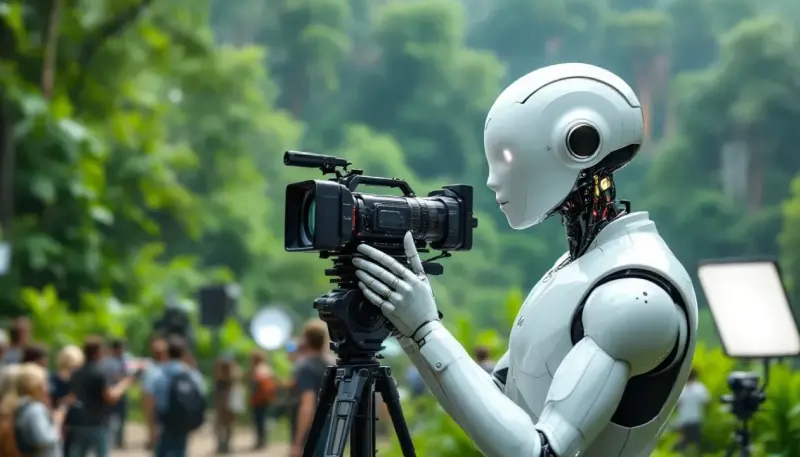
AI video generators have made tremendous progress in recent months - most likely you have noticed this through various posts in your LinkedIn timeline, featuring 5- to 10-seconds-clips. But it makes a difference if you want to create short clips that create “likes”, or generate videos for your business to which customers will relate to.
Anyone who has worked on creating attention on their products and services knows that great images draw attention. In social networks, like LinkedIn, the trend has moved from images to short videos in the last years. As the creation of high-quality videos can be time- and cost-intense, the temptation to leverage generative AI technologies is big.
Where are the limitations of today's AI video generators?
The most relevant limitations reside in challenges on consistency of objects, scene consistency, quality degradation for persons, keeping control over objects, realistic physics and interactions, and bias on how persons and the scenery appears.
Consistency of objects: the more objects, or persons, are part of a video, the more challenging it will be for the AI to visualize them throughout the whole scene consistently. As most AI is limited to generate clips of length not longer than 5 or 10 seconds, creating longer videos means stitching together separate clips - which raises difficulties in this regard.
The leading and latest models, however, moved beyond this limitation of length. Videos of up to 60 seconds are now possible (e.g. with Runway Gen-4). However, the computational efforts are significant, and so are the costs.
Scene consistency: generating images with persons in front of a great background, and then making a video out of it, is possible today. You have good control over how fore- and background look like. Nevertheless, with persons moving in your video, the background scenery will need to change accordingly, so that you will lose control over details in and quality of the background. This limits your ability to create dynamic videos while keeping quality high.
Leading video-AI providers have invested into improving in this regard. If this aspect is important to your video project, you should try out different services and assess how their latest models perform with the specific scenery that is important to you.
Quality degradation for persons: persons can be depicted at great quality with many details. As the seconds in a video pass, the quality tends to decrease, however. Even though the overall quality of the video might still be good, persons will start to look a bit “off”.
Control over objects: in business scenarios, you might want to depict objects that not only look similar to your product - but they must look exactly like it. Within the latest models, you have the ability to provide reference images showing certain products or faces of people. The model then will generate a video that is replicating the look of this reference image. Latest models (like Kling 3 and Wan 2.6) give you the option to provide multiple references - when you want a certain person to hold a concrete object into the camera, this ability is tremendously helpful.
Is this enough to promote an object in high-quality marketing videos? Maybe. AI will struggle if your object has many small details, or if the perspective of how the camera looks on the object changes over the course of the video. In that case, you will face the need to fine-tune an AI on this very object. Which is possible today, even for non-developers. The more objects and persons you want to control, however, the more difficult this will be at satisfying quality level.
Realistic physics and interaction: when people move in a video, cups fall to the ground, hairs of the actor blow in the wind - it must look realistic and physically correct. AI video generators have made tremendous progress in this aspect. "Everyday physics " like reflections, water flowing realistically along a river, throwing balls are possible now - this is because there are many videos which the AI models could access for training.
The more you want to control certain interactions - for example having a person take a cup out of a cupboard, or open a fridge - the chances rise that this will look weird, or even physically incorrect. It adds on the challenges for having control over objects: ensuring that objects and persons look in a certain way, and then controlling how these interact, remains difficult.
If you struggle with a certain interaction in your video: Try improving your video-generation prompt with exact details of how the interaction correctly needs to look like. Further, regenerate the video with different random seed numbers - if one random seed works well, then stick to it. For complex movements, try breaking it up into simpler steps across multiple short clips.
Bias on how persons and scenery appear: This depends strongly on the data on which the AI has been trained. If the AI has learned its capabilities mostly based on Western movies or web clips, then it might struggle on Asian or African settings, or on depicting specific business environments. Which video generators work best for you? You need to find out with trial-and-error yourself.
What are latest trends in AI video generation?
Synchronized audio that aligns to what you see on the video is important. Therefore, AI companies are working heavily on providing models that generate both, the audio stream and the video images. A leading model in this regard is Google's Veo 3.1. Alternatively, there are various models that create only the audio based on an input video you provide.
For general background noise, this already works very well. Your best way to control the details of the audio will be by having the source of the noise anchored in the images of the video. For example, imagine your video needs the sound of a glass that falls to the floor and breaks. If this situation is explicitly visible in the video, you can expect a realistic sound for that. If the situation is only visible in the background, or not visible at all, then you must count on results that don't match to your wishes.
If you want to have humans speaking, then I advise you to switch over to a model that specializes to generate that kind of sound. Native audio models with such a focus now achieve lip-sync accuracy within 120 milliseconds - this is the threshold where humans usually start to recognize discrepancies between what they see and what they hear.
Prices for video generation services: The vast progress that has been made within latest AI video generators comes at high computational demands. Consequently, the prices for generating high-quality videos are significant and will rise further. On a famous note, OpenAI decided to shut down its AI generator Sora. Although it was among the leading AI models in that domain, the OpenAI leadership decided that there is no way to sustainably provide Sora to customers at a reasonable price. Further, the computational resources that previously went into Sora were redirected to their core enterprise models which provide better business opportunities.
Therefore, if you aim for professional videos, it's worthwhile trying out the leading AI models and assess yourself which has the best quality-to-price ratio for your situation.
How should you get started for generating videos?
While video generators are highly capable in many regards, you should reduce the challenges in a video as good as possible. The fewer challenges which the AI will face, the more satisfying results it will produce. Look for the following triggers:
- Can you limit your clip to not more than 10 seconds, or do you need a longer scene?
- Can you reduce the number of persons and objects for which you need exact control over their movements?
- Can the video have a static, background scenery - or at least show only minor changes?
- Have you tried out different video generators in regards to physical correctness, image quality, natural facial expressions, etc.?
How can you improve on controlling what the video shows?
Image generators are better for optimizing the overall scenery and fine-granular details based on your prompts. Therefore, it makes sense to start the video generation not only with a prompt, but with a perfectly optimized image. Some video generators (like Kling 3) let you specify the final image for the video sequence to be generated - therefore, adding a perfectly optimized final image will strengthen your control of how a video sequence ends.
Do you focus on letting a human act in your video scene? Then think about using multiple reference images of the very same person from different perspectives or showing different emotions. The same accounts for cases where an object is at the center of the video: Providing reference images at different lightings and from different sides will increase the quality and control of how it is depicted.
What are the leading AI models for video generation?
As of early 2026, the leading AI video generators are Google Veo 3.1, Kuaishou's Kling 3, Runway Gen-4, Alibaba's Wan 2.6, and ShengShu's Vidu.
- Veo 3.1 made by Google: Strengths in cinematic realism and integrated generation of audio, yet limited to 8 seconds
- Kling 3 made by Kuaishou:A prominent player right now that has filled the void left by Sora, offering highly realistic motion and strong character consistency.
- Gen-4 made by Runway: Although this model was release in early 2025 already, it remains a staple for professional digital artists and filmmakers, offering deep control over cinematic camera movements and object consistency throughout the scene.
- Wan 2.6 made by Alibaba: Being popular for marketers, it provides a pricing that aims for ultra-fast generation of high-definition, social-media-ready clips in just seconds.
- Vidu made by ShenShu Technology together with Tsinghua University: Excels for stylized creative workflows and allows for fast iterations.
How will video generating AI develop in the upcoming months?
Companies will focus on improving capabilities like control over objects, realistic animations of humans and high-quality audio, as these features are crucial for professional video marketing and movie creation.
Generally, Tech companies are continuing their work to further improve on overcoming these limitations. Nevertheless, the current business dynamics raises concerns that we will see significant price increases for future AI models. But maybe, other companies follow the example of OpenAI and focus their research efforts on use cases other than video generation. Therefore, keep track of where innovations in video generation will push its capabilities.
What are recent examples of AI-generated videos in marketing?
In the meanwhile, are you interested in successful examples of AI-generated videos? Take a look at this clip from a family-run shop, or this campaign by The Coca Cola Company in India.
However, the commercials from 2026's Superbowl highlight the limitations auf what AI-generated videos are able to achieve. While most videos were generated or edited with AI, one non-AI clip beat them all in regards to quality and attention. Pepsi hired a team to create a spot of a polar bear, taking several weeks to record in studios and animate via classical CGI software. What sticks out is the realistic animation of the bear's fur, which is hard to copy with today's AI generators.
Besides all the relevant questions we ask about the technologies we put into video generation, it also shows us: For good marketing videos, a thought-through story-telling keeps being the foundation for everything else.