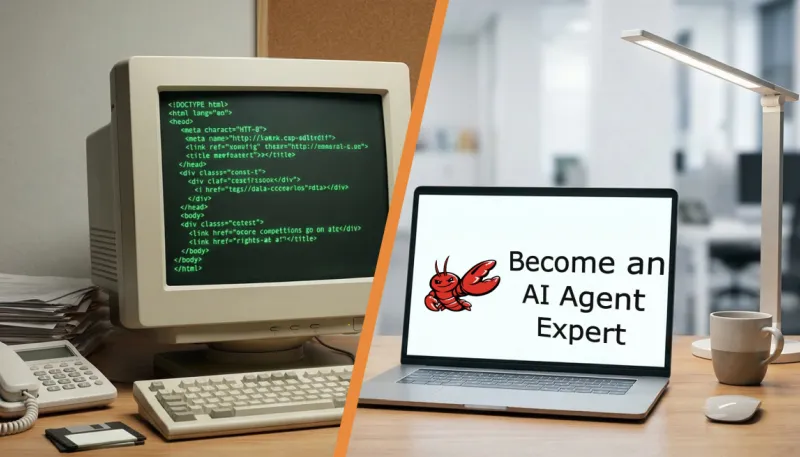
Open LinkedIn these days, or read articles from leading tech experts, and you face a wall of panic. The prevailing narrative is that to survive the coming decade, you must become an AI expert. You are told to buy courses on prompt engineering, master the intricacies of large language models, and fundamentally change your career path to align with AI development.
It sounds obviously true at first glance. We see AI taking over entry-level analytical and research tasks, causing real disruptions in the job market.
But this anticipation is fundamentally misguided. We are confusing building the technology with using the technology. The reality is that the vast majority of the workforce will not need deep AI expertise. They will need AI literacy.
If we look at the history of technological shifts, the future is not about mass technical mastery. It is about domain expertise and the triumph of user experience (UX).
The 1990s HTML Panic
To understand where AI is going, we just need to look at the rise of the internet.
In the early-to-mid 1990s, the narrative was remarkably similar to today. Tech magazines warned that to have a business or a career in the digital age, you had to understand network protocols and learn how to code HTML. Webmasters were treated like wizards who held the keys to the future economy.
Did the future unfold as expected? Absolutely not. Most of us cannot code HTML pages and are doing fine in our jobs.
The software industry realized that demanding mass technical mastery is a terrible business model. Instead, they fixed the UX. Tools like Microsoft FrontPage, Dreamweaver, and eventually WordPress emerged with a revolutionary promise: "No HTML required". Today, you can run a multi-million-dollar digital business without knowing a single line of code - various tools are hiding the code from us while still allowing us to achieve our goals. The internet became fundamental to every job, but deep knowledge of its architecture did not.
That's exactly where AI is heading as well: towards seamlessly embedded solutions that work without deep expertise of that technology.
We are currently exiting this "HTML phase" of AI. The early days of rigid prompt engineering are fading for casual users as companies integrate AI into seamless chat and voice interfaces. These capabilities still matter, but they get increasingly hidden behind user interfaces and workflows. The goal of every major tech company right now is to make AI invisible — to weave it into the tools you already use so that "no prompting is required". Humans inherently value convenience over mastery.
The Path of Industrialization: From Open Chaos to Walled Gardens
This shift toward convenience is not an accident - it is the natural lifecycle of technology. Even back in 2010, in his famous article in Wired, Chris Anderson noted that for any new technology - from railroads to electricity to the telephone - the path of industrialization is always the same: "invention, propagation, adoption, control".
He correctly observed: "There has hardly ever been a fortune created without a monopoly of some sort, or at least an oligopoly... Much as we love freedom and choice, we also love things that just work, reliably and seamlessly."
We are watching this play out in real-time. The market for consumer-facing AI (B2C) is consolidating into massive, heavily capitalized walled gardens. Political and strategic moves play a role, for sure. But as everyday users, we mostly choose the solutions that hide the technological complexity from us and let us focus on our actual tasks.
The exact same dynamic applies to company-facing businesses (B2B), but with a crucial twist: The most valuable "walled gardens" for companies will not necessarily be built by US Big Tech. They will be built by industry-specific businesses that deeply understand their clients' workflows and manage to leverage AI to create perfectly tailored, convenient solutions. For the end-user sitting at their desk, deep technical mastery of what is inside that solution is irrelevant. What matters most is knowing how to use it to get the job done.
Domain knowledge as the human premium
If you don't need to be an AI expert, what skills will actually keep you employed?
There is a popular, dangerous myth right now that today’s AI is already on the verge of flawless superintelligence. It is not. AI is incredibly powerful, but it lacks real-world context, hallucinates facts, and makes highly confident errors.
Because AI will increasingly handle rote generation and basic analytical tasks, the value of a human worker is shifting entirely toward domain expertise.
If an AI can generate a marketing strategy or a legal brief in ten seconds, the valuable employee is not the person who typed the prompt. The valuable employee is the senior marketer or lawyer who possesses the deep, hard-earned domain expertise to evaluate whether the AI's output is actually accurate, legally sound, and strategically viable.
You do not need to be an AI engineer. You need to be a domain expert with the right acumen for what your customers need.
Cultivating AI Literacy
The fearmongering that you must master AI to stay relevant is completely misplaced.
We will still have jobs for tech experts who build the AI components and infrastructure. We have entrepreneurs who build up new services, and need a "secret sauce" that differentiates them from their competition. They will truly need to master AI. But for the majority of jobs, the future belongs to adaptable professionals who possess AI literacy.
But whenever you read a post that you need to become an AI expert, and panick starts to creep in, remember: we've been here before.
AI literacy means understanding the core concepts of the technology so you can use it strategically. It means knowing which tools solve which problems, understanding the legal and ethical risks of the outputs, and knowing how to navigate the walled gardens safely. I'm convinced: Knowing the basics of AI's mechanisms and limitations will already put you ahead of the curve. This is also why I wrote the book "Making Sense of Generative AI" to close the AI literacy gap in approachable language.
But reading is just the first step. If you are a business leader ready to move beyond the basics and build a pragmatic, secure AI strategy for your team — without forcing everyone to become a tech mechanic — let's talk. I offer consulting for B2B companies ready to turn the AI hype into a real competitive advantage. Drop me an email